60,000-Year-Old “High Spectacular” Etchings May Point to Early Human Use of Geometric Design

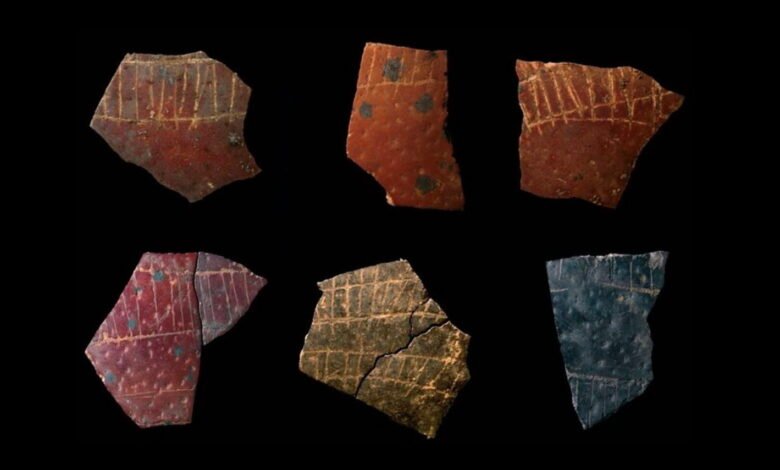
Evidence of first person application of geometric concepts to prehistoric art emerged in southern Africa, revealed in a series of archaeological discoveries which focuses on the complex patterns and repetitions of ancient carvings on ostrich eggshells.
The remarkable finds, discovered at a series of archaeological sites across southern Africa, are believed to have been carved in the first Homo sapiens in the regions around 60,000 years ago—earlier than previous examples on organized marks suggestion to use the geometric rules.
The new findings were made by a research team based at the University of Bologna and reported in a study published in PLOS One.
Echoes of Early Geometry?
As the branch of mathematics that involves spatial properties such as shape, size, and relative position, it is known that the Ancient Babylonians began to use geometrical calculations to track the movement of planets such as Jupiter. at least 1,400 years ago than previously believed.
To compare the etchings discovered by the team led by Silvia Ferrara, a Professor at the University of Bologna’s Department of Classical Philology and Italian Studies, to the capabilities of the ancient Babylonians may not be based. However, the evidence of more basic geometric thinking – apparent repetition, use of parallel lines, presence of angles (orthogonality), and other distinctive geometric organization – in ancient African discoveries is difficult to ignore.
“These clues reveal a strangely structured, geometric way of thinking,” Ferrara said in a statement given at the University of Bologna. Unibo Magazine.
“We’re talking about people who don’t just draw lines,” adds Ferrara, “but organize them according to recurring principles—parallelism, grids, rotations, and systematic repetition: a visual grammar in embryo.”
An Ancient Tale Told by Ostrich Eggs
Ferrara and his team think that the main purpose of ostrich eggs is to carry water. Examination of deeper markings covering several eggshell fragments recovered from a southern trio. Places called Archaeological in Africathe team conducted a quantitative and systematic investigation of 112 samples.
Using statistical analysis and geometric methods of investigation that had not been used for such artifacts before, Ferrara and his team reconstructed the lines and designs of the eggshells.
The results were surprising: Ferrara’s team discovered that more than 80% of the etchings they analyzed showed signs of “coherent spatial regularities” and evidence of repeated orthogonality, with angles close to 90 ° and the angles resulting from the convergence of groups of lines parallel to each other.
Ferrara and the team also point out the complexity of many of the etchings, which include repeating hatched bands, geometric shapes such as simple parallelograms, grid-like motifs, and other features, which they argue are evidence of complex cognitive operations. Beyond the carvings themselves, the marks reveal evidence of rotation, translation, and repetition by ancient designers, who demonstrated remarkable capabilities 60,000 years ago at sites in South Africa and Namibia.
Geometric “Mastery” in Ancient South Africa
“These carvings are organized and consistent,” says Ferrara, “and show a mastery of geometric relationships.”
“It is not just a process of repeating signs: there is real visuo-spatial planning, as if the authors had a general image of the figure in mind before carving it,” he added.

Currently, the meaning or intention behind the marks remains unknown. However, while such questions may not be answered, the deeper evidence provided by ancient marks is more important: clear signs of the thinking capabilities of ancient artists, which show an ability to create a structural composition based on geometric rules – all of which strongly suggest abstract thinking.
Such cognitive capabilities play an important role in generality development of the human mindeventually gave rise to written language, more so complex tool useart, and, finally, the kinds of spatial awareness that lead to the development of geometry and other branches of mathematics.
Valentina Decembrini, PhD student at the Department of Classical Philology and Italian Studies at the University of Bologna and the first author of the new study, said that the analysis carried out by him and his colleagues clearly reveals that the artists who carved ostrich eggs in Africa 60,000 years ago “already possessed a unique ability to organize visual space according to abstract principles.”
“The transformation of simple forms into complex systems by following defined rules is a deep human characteristic that has characterized our history for many millennia,” added Decembrini, “from the creation of decorations to the development of symbolic systems and, finally, writing.”
The team recent study“Earliest Geometries. A Cognitive Investigation of Howiesons Poort Engraved Ostrich Eggshells,” appeared in PLOS One.
Micah Hanks is the Editor-in-Chief and Co-Founder of The Debrief. A longtime science, defense, and technology reporter with a focus on space and astronomy, he can be reached at micah@thedebrief.org. Follow him to X @MicahHanksand on micahhanks.com.