
In June 2024, the White House Office of Science, Technology, and Policy published the National Aquatic eDNA Strategy, part of a larger effort to advance sustainable management of marine and freshwater resources. Members of the MBARI team lent their expertise to help advance and inform this strategy. This plan elevates eDNA as an important tool for mapping and monitoring biodiversity and calls for increased collaboration among public and private agencies to improve and advance eDNA research and operations.
Expanding eDNA technology for monitoring and protecting aquatic ecosystems is critical to this strategy. The strategy aims to standardize eDNA practices, improve data sharing, and set performance metrics for reliable, consistent agency use. Through collaborative research and national standards, this strategy supports U.S. conservation goals by offering a science-driven, cost-effective approach to managing and safeguarding aquatic resources.
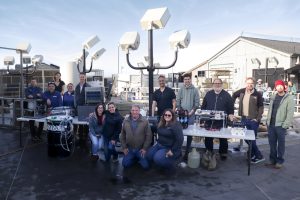
In November, MBARI teamed up with our education and conservation partner, the Monterey Bay Aquarium, to host an experiment for our peers in the eDNA technology field to test and validate autonomous eDNA sampling technologies. The Aquarium’s Animal Care team keeps a detailed record of the fishes, invertebrates, and algae that live in their Kelp Forest exhibit, making it an ideal model to assess instruments’ ability to detect genetic markers from a diverse community of marine life.
The experiment gathered data from MBARI’s 2G ESP, 3G ESP, and FIDO instruments, Cawthron Institute’s TorpeDNA passive sampler being tested through the Synchro research collaboration hosted at MBARI, and instruments commercially available from Aquatic Labs, Dartmouth Oceans Technologies, Inc., McLane Research Laboratories, Inc., Ocean Diagnostics, and Smith-Root.
The nine devices processed water samples from the Kelp Forest exhibit while researchers manually collected and tested water samples for comparison. Findings from this experiment will help the eDNA research community create standardized performance benchmarks that ensure data collected across a range of technologies are consistent. This will improve the scientific community’s ability to share data from biodiversity assessments and enhance decision-making for aquatic environments.