There is a particular kind of weariness that settles over performers who have spent decades being looked at. It isn’t visible at first glance, ageing stars learn to mask it with charisma and posture, but every now and then, a crack reveals itself. Jay Kelly, Noah Baumbach’s latest, seems born from that crack. It opens with a Sylvia Plath quote about the burden of being oneself: “It’s a hell of a responsibility to be yourself. It’s much easier to be something else or nobody at all.” The film proceeds to wonder whether a life lived under unbroken attention is really a life lived at all.
It suggests that some people never shake off this burden of being themselves, truly and without embellishment. And in the next two hours, Baumbach tries, not always successfully, to turn that burden into a meditation on fame, memory, and the making of a man who has lived so long in front of the camera that his own life feels like cinema.

Jay Kelly is a portrait of loneliness dressed up in the comforts of wealth and adoration. George Clooney plays the titular actor as a man simultaneously swollen with success and hollowed out by it, wandering through Baumbach’s version of Europe, a cliched, strangely postcard-like fabrication, all cobblestones and curated melancholy. The film follows Kelly after he wraps his latest project and decides to spend time with his daughter, Daisy (Grace Edwards), who is backpacking across Europe before leaving for college.
News of the death of Peter Schneider (Jim Broadbent), the director who gave Kelly his first major break, becomes a turning point. Kelly had recently refused to attach his name to Schneider’s new film to help secure financing. At the funeral, he runs into his old acting school roommate, Timothy (Billy Crudup), now a child psychologist. If Baumbach’s film has only two unambiguous delights to offer, one is seeing Greta Gerwig back on screen, and the other is Crudup’s electric bar scene with Clooney. Crudup dares you to look away, and you can’t.
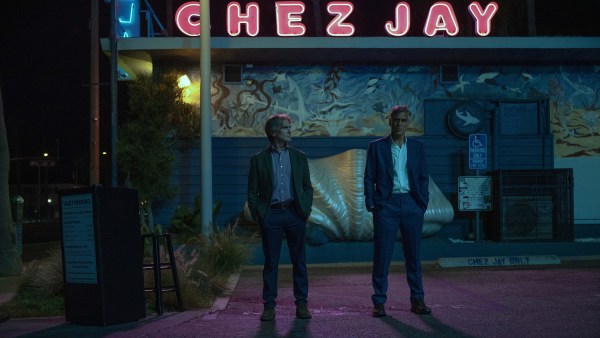 A still from Jay Kelly
Old wounds resurface between Tim and Kelly, leading Kelly to drop out of his upcoming role and impulsively book a flight to Europe, ignoring the pleas of his manager, Ron Sukenick (Adam Sandler). Kelly hopes to surprise his daughter during her travels and also attend a recognition ceremony in Tuscany. The movie then shifts into a travelogue, journeys through scenic Europe in search of purpose, clarity, and absolution.
Clooney works hard to inhabit this meta-character, a version of a version of himself. He brings a softness, a tremor, to Kelly, an elegant man exhausted by his own myth. He confesses to feeling “all alone,” admits that “all my memories are movies,” and offers reflections on fame that are equal parts self-pity and self-awareness. Yet an inescapable “woe is me” fog clings to his arc, partly because the film keeps returning to the idea that being adored is its own tragedy. Baumbach attempts to interrogate that conceit, but too often the film indulges it instead.
Kelly’s pain is palpable, yet oddly remote: we are told he is suffering more than we are ever allowed to feel it. The film explains Jay Kelly to us rather than letting Jay Kelly reveal himself.
Story continues below this ad
The real artery of emotion runs through Adam Sandler’s Ron, the manager, the friend, the man who has spent years orbiting Kelly’s gravity and paid the smaller, quieter price for it. Sandler anchors the film with a warmth that Clooney’s character cannot access, and perhaps is not meant to. While Kelly contemplates the existential tragedy of stardom, Ron shoulders everyday sacrifices, the family time missed, the compromises made, the little heartbreaks endured because someone else’s dream required it. In one scene, Ron says, “You are not Jay Kelly alone. I am Jay Kelly too.” In that line lies the film’s truth: the stardom we celebrate is rarely built alone, yet its rewards are almost always solitary.
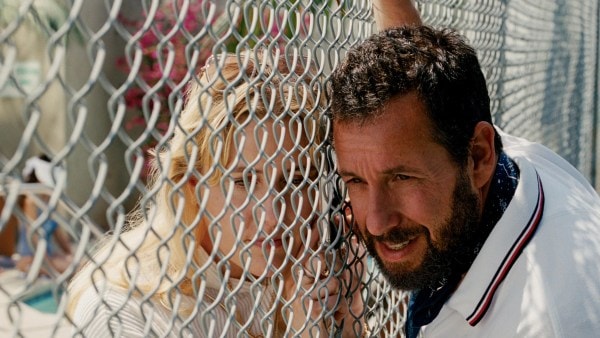 Adam Sandler in a still from Jay Kelly
Baumbach, usually so deft with dialogue and nuance, feels uncharacteristically blunt here. Jay Kelly wants to be an emotional excavation, a Hollywood satire, a meta-commentary on fame, a European character study, and a Netflix prestige piece all at once. You can feel Baumbach wrestling with too many masters, the allure of a bigger budget, the pressure of awards momentum, the comfort of his own familiar thematic terrain, and the streaming platform’s appetite for polish. The result is a film that is fitfully endearing but often curiously airless, experimenting enough to feel alive but indulging enough to feel unfocused.
By the time we reach the ending, intended, presumably, to seal Kelly’s reckoning with his life’s choices, the film circles back to celebrating the career it has spent two hours critiquing. Instead of transcendence, we get something almost solipsistic – an emotional flourish that folds in on itself. It’s a finale that wants to move you but ends up reaffirming that the movie understands Jay Kelly’s myth far better than its humanity.
The film boasts a stacked cast, Patrick Wilson, Riley Keough, and Laura Dern all appear. But the underuse of Dern should be considered an offence. Keough, as Jessica, the older daughter, gets limited screen time but makes the most of it.
Story continues below this ad
Jay Kelly is a strange one indeed: half confession, half performance, and somewhere in the middle, a movie that never quite figures out which one it wants to be.