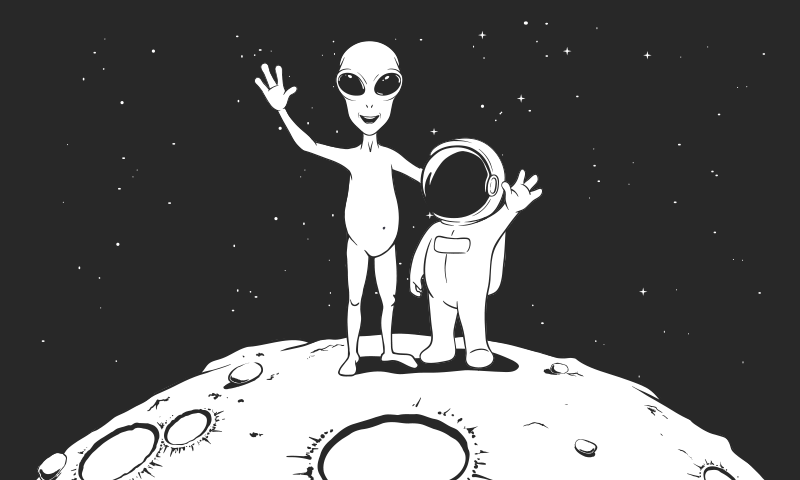
The 1982 blockbuster film E.T. made aliens easy to love. In the film, a crinkled extraterrestrial being with large expressive eyes—looking like the love child of a turtle and an ape—takes shelter in the home of a young boy named Elliott after getting stranded on Earth. For the bulk of the movie, Elliott protects his otherworldly friend from government agents, who treat E.T. as a threat, the same way they might treat a deadly virus or an explosive device. E.T., who clearly displays intelligence and a complex emotional life, has no rights.
While the popular film is entirely fictional, and scientists have yet to detect life outside of Earth’s atmosphere, the hunt has quickened in recent years. With advanced telescopes, astronomers can now identify and image potentially habitable exoplanets and moons. They send autonomous probes to sample alien atmospheres for signs of biological activity. And with rovers like Perseverance, they seek biosignatures in the Martian soil. These explorations, and growing efforts to commercialize space, lend an urgency to ethical questions about extraterrestrial life. If living things do exist outside of Earth, and we come face-to-face with them, how should we treat them? What kinds of rights should they have? And who decides?
Legal rights should apply not just off-Earth life, but off-Earth ecosystems.
Now a trio of scientists from the United Kingdom—one astrobiologist, one earth scientist, and one legal scholar—have weighed in on these questions. In a recently published Space Policy paper, they suggest that a framework for the rights of extraterrestrial life should take inspiration from the “rights of nature” movement, which promotes a model of legal guardianship as a way to protect forests, rivers, mountains, even individual ocean waves. Instead of requiring a person or group to prove in court that they were harmed by some environmental disturbance, the rights of nature framework allows a designated person or a group to directly represent the forest or river, which have rights of their own. This guardianship model has long applied in cases where parties that can’t represent themselves, such as children, need protecting.
The legal origins of the rights of nature movement can be traced back to a paper published in 1972 by scholar Christopher Stone, provocatively titled, “Should Trees Have Legal Standing?” But it took a few decades for the idea to gather momentum. Today rights of nature is a global phenomenon, enshrined in local and national governance and even in the constitutions of some countries, such as Ecuador. The United Nations recently hailed it as the fastest growing legal movement of the 21st Century.
In their Space Policy paper, the U.K. scholars tally the rights of nature successes and suggest that expanding the “circle of rights beyond Earth” will require environmental conservation groups to join forces with groups that govern activities in space, such as the United Nations Office of Outer Space Affairs.
Legal standing for extraterrestrial life could be achieved, they say, by applying existing international environmental law, such as the convention on biological diversity, to space missions and creating a system of guardianship that could represent ETs when missions are planned.
Legal rights should not only be afforded to off-Earth life, but off-Earth ecosystems, the authors write. “This definition of ET that we consider for standing is in line with Stone, whose most frequently employed example in ‘Trees’ was that of a river, an environment that hosts life while the water is itself not alive.”
Of course, if intelligent extraterrestrials exist, they may well be able to speak for themselves, rather than require legal guardians to represent them. So the authors are less worried about Spielbergian E.T. creatures with inner emotional lives than about the hidden microscopic extremophiles that may lurk under the ice on Europa, for example, and the vast liquid ocean that may feed them. Either way, the idea is to set up protections in advance, and to recognize the inherent right of all forms of life in the cosmos to exist.
To read more about rights of nature and extraterrestrials in the pages of Nautilus, check out these stories:
This Ocean Wave Has Rights: The true meaning of legal protection for nature
This Cloud Forest Should Not Exist: The story of an Ecuadorean forest that fought annihilation and won
Who Speaks for the Whales: Rights for cetaceans are not enough. They also deserve representation.
If You Meet ET in Space, Kill Him: Should an alien species resist, we will have discovered life
The Odds that Aliens Exist Just Got Worse: How geology resolves the Fermi paradox