Hubspot Company Research Agent
Hubspot
HubSpot is taking a clear swing at the future of work. At its INBOUND 2025 event today, the company announced more than 200 product updates. But the message isn’t just about bolting AI capabilities onto existing tools, it suggests a reset in the thinking of how humans and machines work together.
Karen Ng, EVP and Head of Product, explains, “The companies that win won’t be the ones with the most AI tools. They’ll have the smartest hybrid teams where AI doesn’t replace people, but multiplies their impact.”
That’s a direct answer to many of the criticisms of how AI is being put to use and recent surveys questioning AI’s long-term viability in the industry. Many technology firms have been piling AI features onto existing stacks, showing middling results. However, HubSpot aims to reframe the conversation by suggesting that it’s not what we do, but the way that we do it that counts.
From AI as Side Projects to Core Strategy
HubSpot CEO Yamini Rangan shared a vision for the hybrid human-AI workforce called the “Loop”. This vision changes the standard marketing conversion funnel from a top-down awareness to conversion pipeline to a loop consisting of four iterative stages. Organizations should “express” who they are, then “tailor” their message to specific customers using hyperpersonalized approaches, and further “amplify” this message across as many customer touch points as possible and continuing to “evolve” that message in real time, looping back to the start of the loop.
The “Loop” Iterative AI-centric marketing path
Ron Schmelzer, at Hubspot INBOUND25
HubSpot frames its approach differently from others in the market. Salesforce, Microsoft, and Zoho each tout their own assistants that aim to automate and facilitate existing processes, but HubSpot is positioning itself as the platform where AI isn’t an add-on, it’s a valued part of the team that is plugged into the core of organizational data and processes. The company is aiming not to be another vendor with AI accessories, but as a place where digital teammates sit inside the core of customer data and daily workflows.
Ng outlined a three-step flow that mirrors how a new hire joins a business and adds value. First comes onboarding. HubSpot’s new Data Hub, which replaces Operations Hub, pulls in structured CRM records, emails, call transcripts, and outside signals. It combines data prep with pieces of data engineering pipelines to give agents the information they need.
“Most businesses are making 100% of their decisions with only 20% of the data,” Ng says, citing internal benchmarks.
The second step is embedding AI in daily routines to cut out busywork. That means helping humans focus on judgment and creativity while agents handle preparation. Marketing Hub can now generate campaigns from a single canvas. Commerce Hub drafts quotes and flags risks in deals. Sales Hub prepares meeting notes and conversation insights automatically.
The final step is assembling mixed teams of humans and AI. HubSpot introduced Breeze Agents to act like full-time teammates. Breeze Assistant and Custom Assistants can be tuned for narrower roles.
The Increasing Role of Agents
Breeze Agents come in several types. Service agents handle routine customer requests and route only complex cases to people. Prospecting agents scan for buying signals, research accounts, and send outreach. Closing agents take on quote generation and standard pricing so sales teams can concentrate on negotiations. Data agents enrich CRM records with missing details in real time.
Ng said the pipeline is still expanding. In public and private betas, the company expects to test more than a dozen new agents. Examples include a Knowledge Base Agent that drafts support documents, a Customer Health Agent that predicts churn, and a Blog Research Agent that tracks market trends.
“We’ve all been on the receiving end of a cookie-cutter email, and everyone knows it doesn’t work,” Ng says. “That’s not what these agents are doing.”
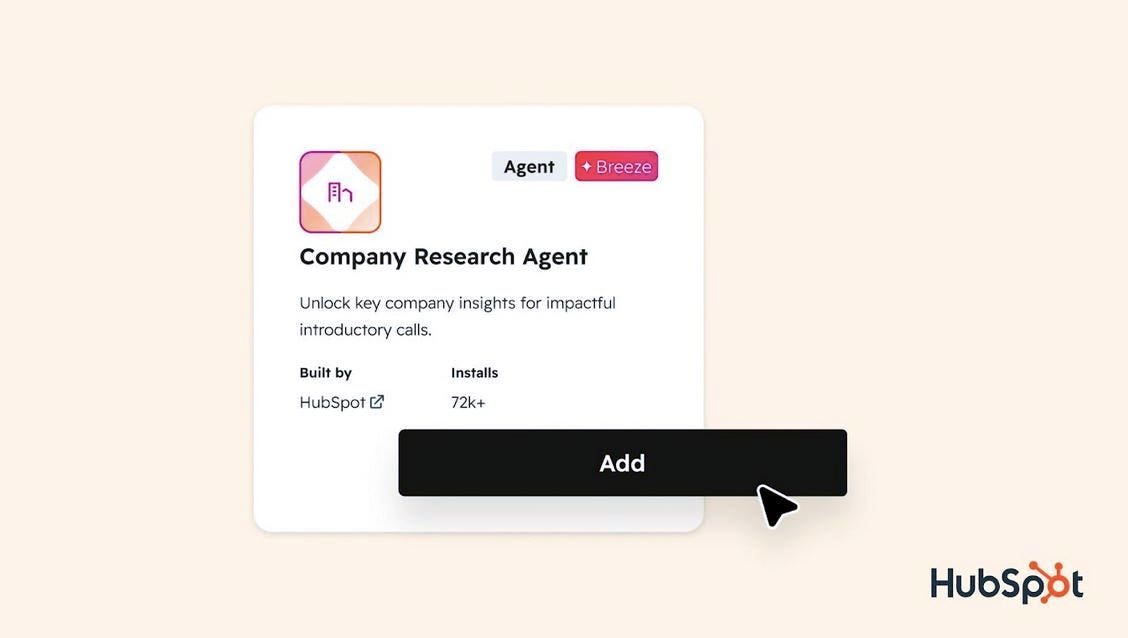
To support that claim, HubSpot is releasing Breeze Marketplace, a place where companies can browse and install agents. Breeze Studio then serves as the management and customization hub so businesses can tune agents to their own needs.
An Increasingly Competitive Market
The rush to enterprise AI mirrors the surge of software-as-a-service and cloud tools a decade or so ago. Rivals are investing fast to stay ahead of customer demand. Salesforce launched Einstein GPT with integrations into Slack and Tableau. Microsoft is broadly advancing Copilot integrated with Office and Teams, built for productivity across departments. Zoho’s Zia has added conversational help and AI-enhanced capabilities throughout its suite.
But tools and technology are not the main core of HubSpot’s challenge. Skills, experience, and application remain the sticking point. Sales, marketing, and service teams will need to learn how to work with AI as partners.
“The new skill is learning how to guide AI teammates by setting clear instructions, applying guardrails, and coaching them to be more effective,” says Ng. “ We’re embedding education and intuitive design into the product so customers can make that shift naturally without disruption.”
The AI boom has long promised significant benefits, but productivity gains often stall when humans can’t trust or contextualize the outputs. To meet this challenge, the company says that every agent is built with human oversight in mind. Drafts wait for sign-off. Quotes pass through review. Controls prevent agents from going rogue.
Ng puts it plainly, “We’ve built everything around the principle that people lead and AI accelerates.”