Real-Time Night-Sky Surveillance: Millions of Nighttime Signals from Space Expected as Rubin Observatory Comes Online

Welcome to this edition of The Intelligence Brief… This week, the NSF–DOE Vera C. Rubin Observatory released its first real-time sky alerts, inaugurating a powerful monitoring system that astronomers say could change the way people study a dynamic universe. In our analysis, we will look at 1) how the observatory’s automated pipeline can generate up to seven million alerts per night, 2) the types of events already detected—including asteroids, supernovae, and active galactic nuclei, 3) how the upcoming Legacy Survey of Space and Time will generate a decade-long 4) new sky records, and ancient times that can believe this new skylapse record in the south. Ushering in a new era of discovery by allowing researchers to follow cosmic events as they unfold in real time.
Quote of the Week
“Rubin’s alert system is designed to allow anyone to identify interesting astronomical events with enough notice to quickly obtain time-critical follow-up observations.”
– Eric Bellm, University of Washington Astronomer
If you enjoy the news and views offered by The Debriefmake sure you don’t miss our stories by making us one of your “preferred sources” on Google News. You can follow this link to increase The Debrief in your favorites list, and you can read more about Google’s preferred sources in our recent article here.
NEW NEWS from The Debrief
Rubin Observatory Launches Landmark Real-Time Night Sky Monitoring Effort
A new real-time monitoring system that will scan the night sky for scientific discoveries has been launched, with its official first set of alerts.
The promising development is reported through the NSF–DOE Vera C. Rubin Observatorymarking what it described as “a historic event in astrophysics.”
Astrophysicists expect the number of nightly alerts to rise to seven million—you read that right, up to seven million alerts per night—launching a new wave of 21st century discoveries that will focus on what’s happening in the night sky.
The Heritage Survey of Space and Time
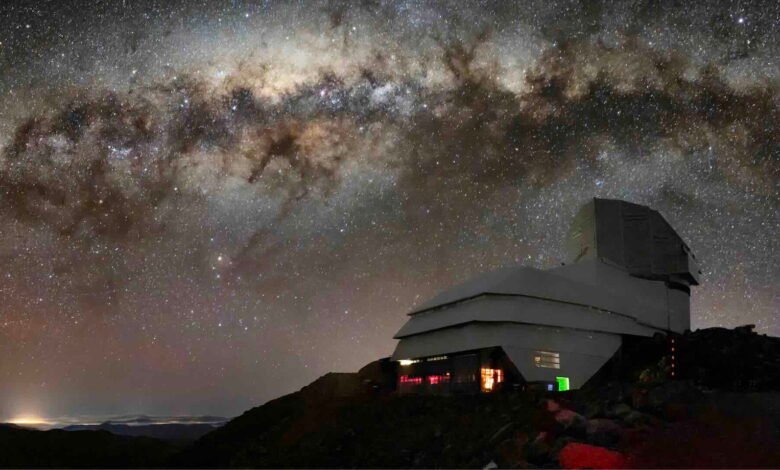
The Vera C. Rubin Observatory, jointly funded by the US Department of Energy’s Office of Science (DOE/SC) and the US National Science Foundation (NSF), is an astronomical observatory located in Chile’s Coquimbo Region.
Formerly known as the Large Synoptic Survey Telescope, the Rubin Observatory’s primary mission is its astronomical survey of Earth’s southern sky, each “pass” of which is completed every few nights. Over the next decade, it will complete the Legacy Survey of Space and Time, a ten-year time-lapse record that will provide a wealth of data for astronomers.
With the release of its first batch of alerts, Rubin has released to the public a total of 800,000 alerts it collected earlier this week on the evening of February 24. Here’s a look at some of what it found as its decade-long mission continues.
A First Look at Rubin’s First Batch of Alerts
In its first release, Rubin’s alerts from this week bring to astronomers’ attention several objects and events that represent changes in the night sky. Among these are detection of asteroids, supernovaeactive galactic nuclei, and more.
Rubin is expected to make an unprecedented number of detections of asteroids, comets, and other moving objects over the next decade. It will also include the detection of interstellar objects, like the mysterious 3I/ATLASwhich captured the interest of much of the astronomical community after its discovery last summer and which the Rubin Observatory was able to describe even before its “official” discovery.
Supernovaeor stars that show intense brightness to coincide with their explosion, have also been detected. Such detections are important because they help astronomers look for evidence of a supernova progenitor star, which new studies reveal surprisingly hard to seeprobably due to the large amount of dust surrounding them blocking the light needed to detect them.
Active galactic nuclei compact regions located in the centers of galaxies. They are of interest to astronomers because they produce a lot of energy that spans the electromagnetic spectrum. In addition, they emit light in ways that are very different from stars, which are observed in different frequency bands.
An Important Milestone
In a statement released this week, the Rubin Observatory said the release of the first batch of alerts marks “one of the last major milestones” before the Legacy Survey of Space and Time mission begins later in 2026.
Once launched, the Survey will capture subtle changes in the night sky with greater precision than any previous astronomical survey.
“These alerts will record the wealth of scientific discoveries Rubin will make through his time-lapse record of the Universe,” the Observatory’s statement reads, adding that by the end of its first year, the Legacy Survey of Space and Time is expected to “take pictures of more objects than all the optical observatories combined in human history.”
Luca Rizzi, a program director for the research infrastructure of the US National Science Foundation, said that the data provided by the Rubin Observatory to the astronomical community in the next decade “will make it possible to follow the events of the Universe as they happen, from the explosive to the faintest and transient.”
Kathy Turner, the current program manager with the High Energy Physics program at the US Department of Energy’s Office of Science, echoed Rizzi’s statements, adding that “The discoveries reported in these alerts demonstrate the power of the NSF-DOE Rubin Observatory as a tool for astrophysics and the importance of continued federal support.”
“Rubin Observatory’s groundbreaking capabilities reveal untold astrophysical treasures,” Turner said this week“and expanding scientists’ access to the changing universe.”

That concludes this week’s installation of The Intelligence Brief. You can read previous editions of our newsletter on our websiteor if you found this installment online, don’t forget to subscribe and get future editions by email from us here. Also, if you have a tip or other information you want to send directly to me, you can email me at micah [@] the debrief [dot] org, or contact me at X: @MicahHanks.