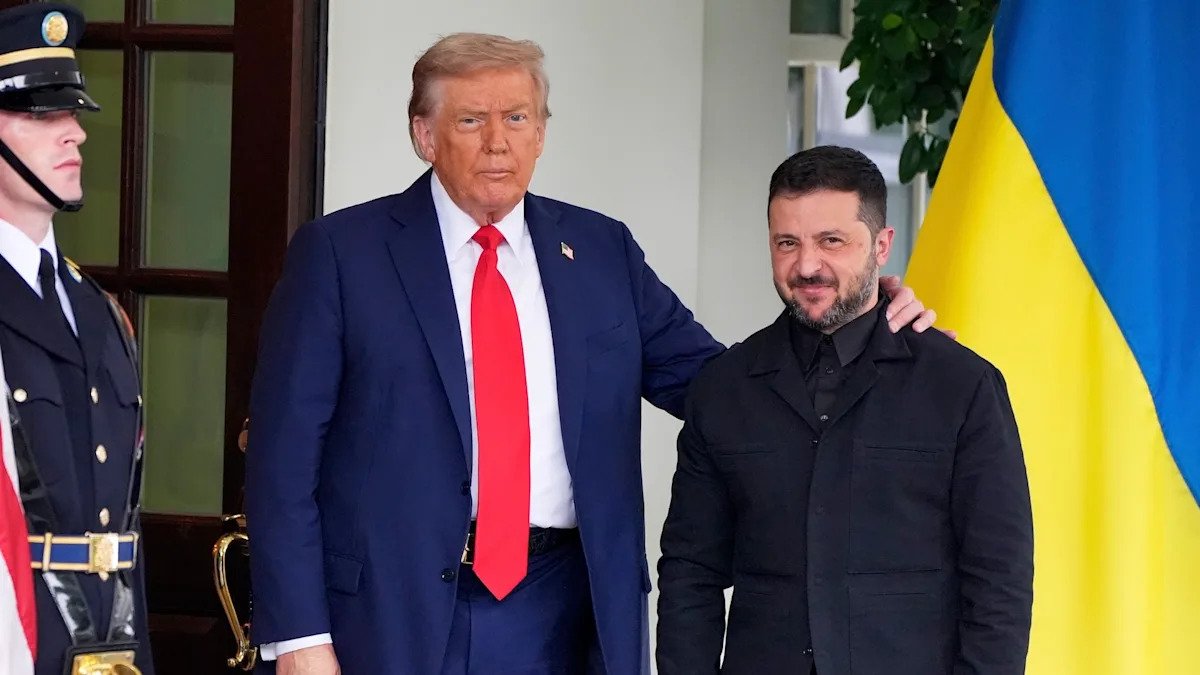
When the leaders of the United States, Russia, Ukraine and several European nations met in a series of summits over the past week, their stated objective was to find a way to bring an end to Russia’s war against Ukraine. But the meetings in Alaska and at the White House played out against a larger, arguably more consequential backdrop.
The search for a solution to that war is also a struggle over the future of the global order, as how the conflict ends will have lasting consequences for the geopolitical balance of power.
Russian President Vladimir Putin’s all-out invasion of Ukraine in 2022 had goals beyond the annexation of a sovereign nation that Moscow used to rule. When he sought to take over Ukraine, Putin was trying to increase Russia’s relative global power, which meant diminishing the dominance of the U.S. and the trans-Atlantic alliance. It marked another step toward reestablishing Russia’s sphere of influence, which he would like to see encompass the former territories of the defunct Soviet Union, and perhaps even the Russian Empire.
His move against Ukraine, which broke the postwar taboo against conquering and subjugating another nation through military force, was a geopolitical earthquake and a direct challenge to NATO, Europe and the U.S. That’s why then-President Joe Biden rallied NATO to provide material and diplomatic support to Kyiv, rejecting Moscow’s right to seize territory by force and vowing to hold no negotiations with Putin without Ukraine’s participation.
To get more in-depth news and expert analysis on global affairs from WPR, sign up for our free Daily Review newsletter.
By contrast, when Biden’s successor, Donald Trump, met Putin in Alaska, he broke the West’s vow of “nothing about Ukraine without Ukraine.” More importantly, when Trump made it clear that he backed a future resolution of the conflict premised on Russia keeping parts of Ukraine, he gave his tacit approval to the notion that a country can change internationally recognized borders by force. That is a very dangerous precedent.
Few have articulated the risk with as much clarity as the historian Yuval Noah Harari. In 2022, days before Putin launched the invasion, Harari recalled how over much of history, war was an acceptable, routine, even positive aspect of statesmanship, but that notion changed in the decades following World War II. Harari warned that if it “again becomes normative for powerful countries to wolf down their neighbors,” the consequences would be felt across the globe. Among other things, he explained, “a return of the law of the jungle” would bring “sharp increases in military spending at the expense of everything else.”
The search for a solution to the war in Ukraine is also a struggle over the future of the global order.
We have already seen that across Europe, where NATO members are dramatically raising defense spending, concerned about where Putin might strike next.
Writing again in 2024, Harari also warned about the ramifications of how the war might end. “If Mr. Putin is allowed to win in Ukraine,” he wrote, “this kind of imperialism will make a comeback all over the world.” A Russian victory, he predicted, will raise anxiety everywhere among countries that had once felt secure in their borders.
The Alaska summit, where Putin persuaded Trump to give up his threats of increased sanctions on Moscow and convinced him to forget his demand for an immediate ceasefire, was viewed as a disaster by most of Ukraine’s partners and supporters. But Ukrainian President Volodymyr Zelenskyy and an accompanying support squad of European leaders reversed much of the losses in a subsequent follow-up meeting with Trump in Washington, demonstrating that they have learned how to play the U.S. president.
The Europeans had multiple goals. Not only did they want to convince Trump of the need to provide strong security guarantees to Ukraine, they were also there to protect their own interests. Europe—including the U.K.—wants to bolster its relevance in diplomatic efforts to end the war, but also in global affairs more generally. More immediately, it wants to protect its own security from an aggressive Russia, which means strengthening the trans-Atlantic alliance, of which the U.S. is the strongest member, although its commitment has come into question under Trump.
The images of Trump sitting in the White House with the leaders of Europe’s biggest countries as well as the top representatives of NATO and the European Union were striking. The meeting was beyond cordial. The seasoned politicians exuded warmth toward Trump, and the U.S. president reciprocated.
The pictures alone helped to strengthen an alliance that has already grown bigger due to Putin’s invasion of Ukraine, which persuaded Sweden and Finland to give up on their historical neutrality and join NATO.
But the picture of unity belied a new reality. Certainly, the convivial meeting was a welcome change from the horrific spectacle of Trump and Vice President JD Vance berating Zelenskyy in the Oval Office in February. That traumatizing event made it clear that any meeting with the unpredictable Trump is a gamble. No one was sure that Monday’s gathering would not unravel into another diplomatic calamity.
But the truth is the European leaders came to Washington not because the alliance is so strong, but because its unity is in question. They tore up their schedules and rushed to Washington on short notice not because they wanted to strategize together as a single-minded group of friends, but because they feared that Trump would pressure Zelenskyy to make unacceptable compromises. They were there to protect Ukraine as much from the United States as from Russia. And as mentioned, they were also there to look after their own security and their relevance in world affairs.
The meeting certainly reinforced the newfound veneer of solidarity among the trans-Atlantic alliance that emerged from the successful NATO Summit in June. But there’s no question that, beneath the surface, NATO is more divided today than it was under previous U.S. administrations, with the Ukraine war now the biggest test of its effectiveness. In this sense, the emerging plan to provide security guarantees to Kyiv, which Trump said would be spearheaded by Europe but backed by the U.S., was a positive step.
Another big question raised by recent events is where exactly the U.S. stands today on the global stage. Trump has put Washington, or rather himself, at the center of global affairs, seeking to become the man who ends not only the war in Ukraine but others as well, as he openly pursues a Nobel Peace Prize. But his repeated threats against Russia—first the deadline for a ceasefire, then the promise of “very severe” consequences if Putin failed to oblige—vanished after a single conversation with the Russian leader. This suggested that Washington’s bark is worse than its bite, a counterproductive message for a country that wants to project power without having to use force.
It’s exactly the wrong stance if global stability is to continue to depend on Pax Americana.
The multilateral meeting in Washington helped undo much of the damage from the bilateral summit in Alaska. But there’s little question that the outlines of what Trump sees as a plausible way to end the Russian war against Ukraine bode ill for the future of global peace.
Frida Ghitis is WPR’s senior columnist and a contributor to CNN and The Washington Post. Her WPR column appears every Thursday. You can follow her on Twitter and Threads at @fridaghitis.
The post The End of the Russia-Ukraine War May Be as Consequential as Its Start appeared first on World Politics Review.