This Tiny Dinosaur Fossil May Offer a Missing Link That Explains the Spread of a Unique Class of Dinosaurs

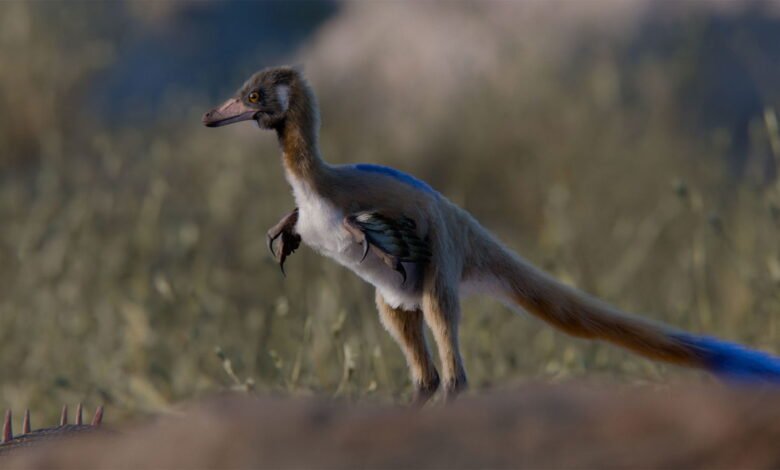
A little dinosaurs type, Alnashetri cerropoliciensisbe the missing link to understand a group of birds dinosaurs called Alvarezsaurs, after the discovery of the first complete fossil in Argentina, according to paleontologists.
University of Minnesota Twin Cities paleontologist Peter Makovicky co-led the research with Sebastian Apesteguía of Argentina’s Universidad Maimónides, with the pair presenting their 90 million year old. fossil discovered in a recent paper published in NATURE.
the dinosaurs Alvarezsaurus group is defined by its small teeth and short arms, which end in a single nailfeatures that researchers suspect are adaptations to the ants’ diet.
La Buitrera Fossil Site
Mystery has shrouded the Alvarezsaurs for decades. While well-preserved specimens are known in Asia, their presence in the South American fossil record is limited to incomplete occurrences that are difficult to interpret. In 2014, paleontologists discovered the first complete Alnashetri fossil. They found a region in Patagonia, Argentina, called La Buitrera, known for fossils from the Cretaceous period.
“After more than 20 years of work, the fossil site of La Buitrera has given us a unique insight into small dinosaurs and other vertebrates that cannot be found anywhere else in South America,” said Apesteguíais a researcher at Universidad Maimónides in Buenos Aires, Argentina.
An Incomplete Fossil Record
Before this discovery, traces of fragmentary fossils alerted paleontologists to the existence of the species, even giving it its name, but it wasn’t until 2014 that researchers had their first full look at Alnashetri. It took a decade of delicate work to safely assemble the dinosaur’s unique anatomy.
“Going from fragmentary skeletons that are difficult to interpret, to a nearly complete and articulated animal is like finding a paleontological Rosetta Stone,” said Peter Makovicky, lead author of the paper and a professor in the University of Minnesota Department of Earth and Environmental Sciences. “We now have a reference point that allows us to accurately identify many scrappy finds and map out evolutionary transitions in anatomy and body size.”
This “missing link” provides paleontologists with valuable information about how the
Alvarezsaurus spread throughout the world, becoming smaller as they evolved. Alnashetri’s small size, but relatively long arms and large teeth, indicate that size was established within the Alvarezsauria lineage before some of its most distinctive features evolved.
Digging Deep in Alvarezsaurus
Based on microscopic analysis, the researchers determined that the specimen represented an adult of the species, aged 4 years or older. While the largest Alvarezsaurus was small for a non-avian dinosaur, only about the size of a human, Alnashetri was one of the smallest dinosaurs ever discovered in South America, weighing only 2 pounds, based on paleontologists’ calculations.

After analyzing the Alnashetri fossil, the team examined other Alvarezsaur remains in museum collections in North America and Europe. These comparisons show that these dinosaurs began during the supercontinent Pangea, which is much earlier than expected. The discovery centers on how the group spread over land in the distant past, rather than later sea voyages.
“We’ve seen the next chapter in the Alvarezsaurid story there, and it’s in the lab being prepared right now,” Makovicky added.
Research continues, both in the Alnashteri lab, and in a broader effort to add to the expanding Cretaceous-era fossil record through ongoing excavations at La Buitrera.
The paper, “Argentine Fossil Rewrites the Evolutionary History of a Confounding Dinosaur Clade,” appeared on NATURE on February 25, 2026.
Ryan Whalen covers science and technology for The Debrief. He holds an MA in History and a Master of Library and Information Science with a certificate in Data Science. He can be reached at ryan@thedebrief.org, and follow him on Twitter @mdntwvlf.
Source link